Zeolites (Poster v22n5)
October 31, 2026
Zeolites, June 2026, Vol. 22, No. 5
November 12, 2026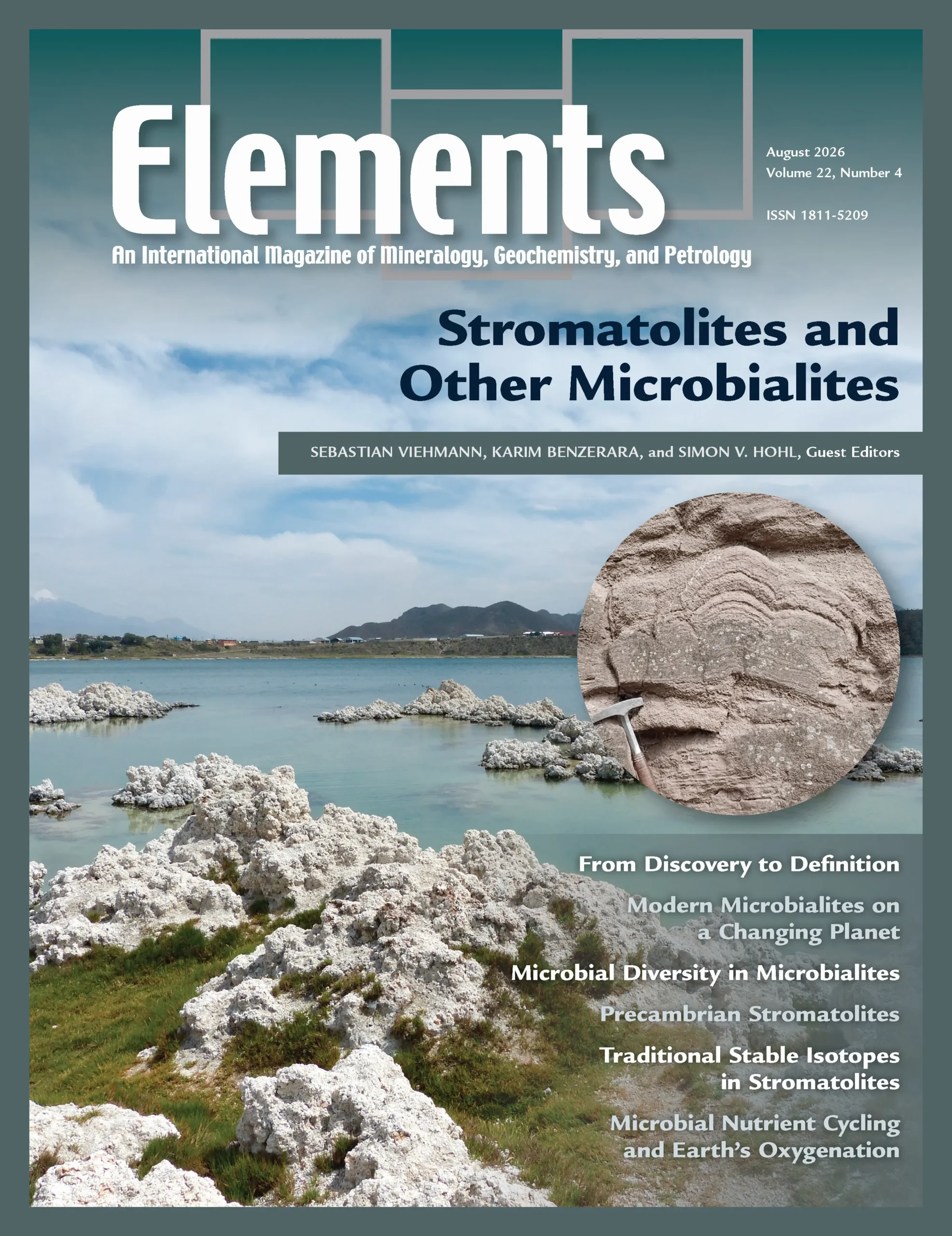
Stromatolites and Other Microbialites, June 2026, Vol. 22, No. 4
$20.00
Discover the fascinating record of Earth’s earliest life with this issue of Elements dedicated to stromatolites and other microbialites. From billion-year-old Precambrian formations to living modern analogues, explore how microbial communities shaped our planet’s geochemical evolution, drove global oxygenation, and preserved vital isotopic biosignatures. A must-read exploration of geobiology, microbial diversity, and the deep history of life on Earth.
Stromatolites and Other Microbialites
August 2026, Vol. 22, No. 4
Stromatolites and microbialites represent some of the earliest and most resilient records of life on Earth. Formed by complex microbial communities interacting with their sedimentary and geochemical environments, these organosedimentary structures offer a profound window into the evolution of the biosphere, early ecosystems, and planetary history spanning billions of years from the Precambrian to modern aquatic environments.
Beyond their fossil heritage, modern microbialites thrive in unique environments across the globe, serving as living laboratories for geobiological research. These living structures provide crucial insights into microbial diversity, metabolic interactions, and nutrient cycling, helping scientists understand how microbial life drove pivotal milestones in Earth’s history, most notably the Great Oxidation Event and the subsequent oxygenation of our oceans and atmosphere.
This issue of Elements, guest-edited by Sebastian Viehmann, Karim Benzerara, and Simon V. Hohl, presents a comprehensive exploration of stromatolites and other microbialites. The articles examine their scientific classification, the biogeochemistry of Precambrian and modern formations, and how traditional stable isotopes decode ancient environmental conditions and biosignatures on a changing planet.
Why You’ll Love Stromatolites and Other Microbialites:
- Journey to the Origins of Life: Uncover the ancient record of Precambrian stromatolites and examine Earth’s earliest preserved biological communities.
- Decipher Biogeochemical Clues: Learn how traditional stable isotopes and geochemical proxies reconstruct ancient nutrient cycles and Earth’s oxygenation history.
- Investigate Living Microbialites: Explore modern microbialite systems, their diverse microbial architectures, and how they persist and adapt on a rapidly changing planet.
- From Discovery to Definition: Trace the evolution of microbialite research—from early historical discoveries to cutting-edge frontiers in geobiology and astrobiology.
Expand your understanding of Earth’s oldest geobiological archives and discover how microbialites continue to illuminate the co-evolution of life and our planet.
Related products
-
On The Cutting Edge: Teaching Mineralogy, Petrology, And Geochemistry, April 2007, Vol. 3, No. 2
$20.00New advances in research on learning have important implications for teaching mineralogy, petrology, and geochemistry. Effective instructional practices are increasingly student centered, address diverse student learning styles, and employ a variety of active-learning strategies.
-
Platinum-Group Elements, August 2008, Vol. 4, No. 4
$20.00The geoscientific and economic significance of the PGE is immense. Due to their extreme siderophile and chalcophile behaviour, the PGE are highly sensitive tracers of geological processes involving metal and sulfide phases.
-
Glasses And Melts: Linking Geochemistry And Materials Science, October 2006, Vol. 2, No. 5
$20.00Geological interest in studying melts stems from early recognition that melts play a fundamental role in determining the physical and chemical behaviour of magmas and magmatic processes. However, due to the inherent difficulties associated with working at high temperatures, much of the geological research over the last 30 years has used quenched melts or glasses as proxies for melts themselves.