Re-Os – Clock with Clout, August 2025, Vol. 21, No. 4
May 11, 2026
The Variscan Orogeny in Europe – Understanding Supercontinent Formation, December 2025, Vol. 21, No. 6
May 11, 2026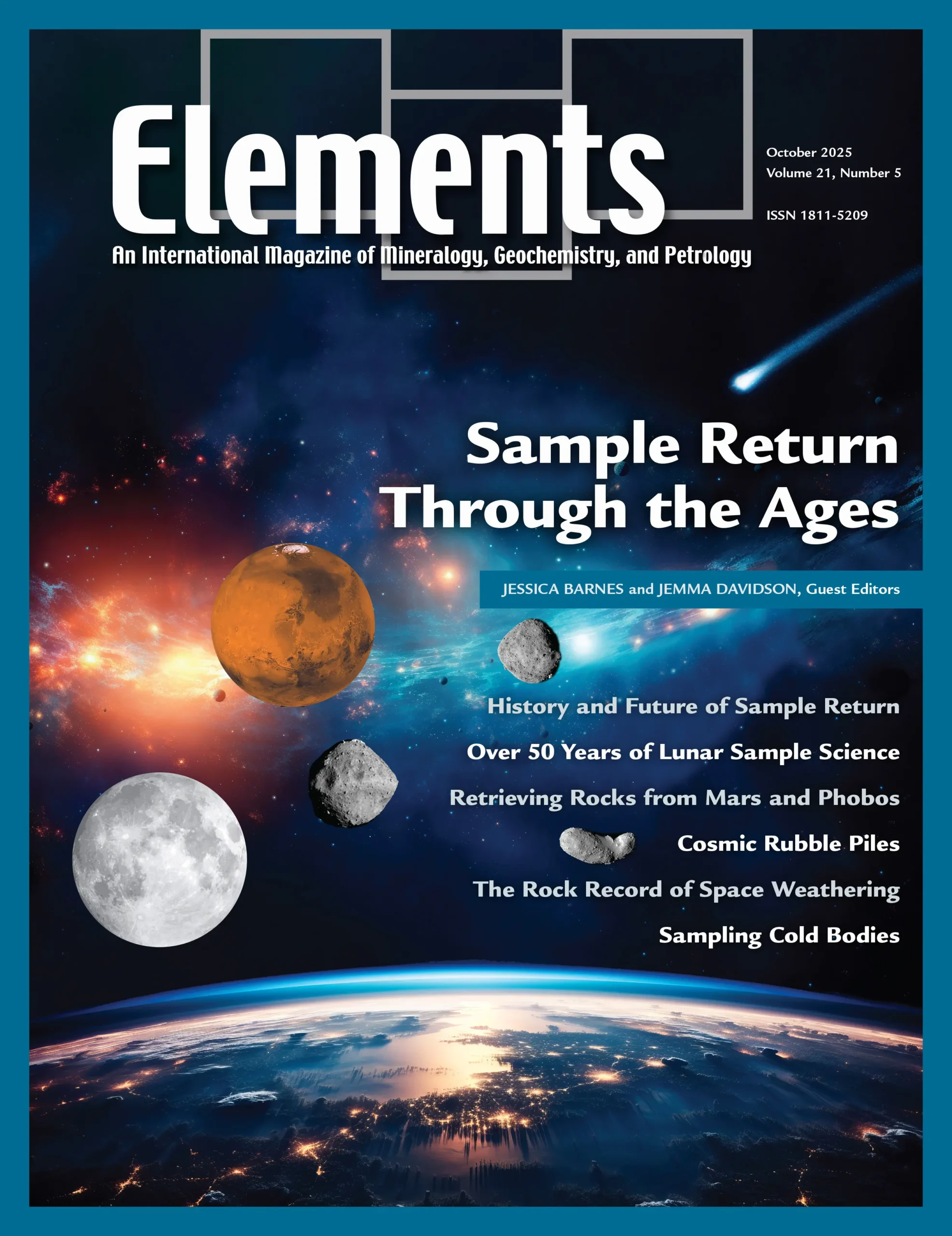
Sample Return Through the Ages, October 2025, Vol. 21, No. 5
$20.00
This exciting issue of Elements explores the extraordinary scientific discoveries made possible through sample return missions from across our solar system. By studying extraterrestrial materials collected by both crewed and robotic missions, scientists have gained unprecedented insights into the mineralogy, petrology, and geochemistry of planetary bodies ranging from the Sun and Moon to asteroids, comets, and Mars.
Sample Return Through the Ages
June 2025, Vol. 21, No. 5
This exciting issue of Elements explores the extraordinary scientific discoveries made possible through sample return missions from across our solar system. By studying extraterrestrial materials collected by both crewed and robotic missions, scientists have gained unprecedented insights into the mineralogy, petrology, and geochemistry of planetary bodies ranging from the Sun and Moon to asteroids, comets, and Mars.
Each article focuses on a specific celestial body or mission series, highlighting how returned samples have transformed our understanding of planetary formation, geological evolution, and the chemical history of the solar system. The issue also examines current and future mission concepts designed to expand humanity’s knowledge of space through advanced sample collection and analysis.
Why You’ll Love Sample Return Through the Ages:
- Planetary Science Discoveries: Explore groundbreaking findings from lunar, Martian, asteroid, and comet sample return missions.
- Mission Histories & Future Exploration: Learn about past achievements and upcoming missions that aim to uncover new secrets of the solar system.
- Extraterrestrial Geochemistry: Gain insights into the mineralogical and chemical composition of celestial bodies through direct laboratory analysis of returned samples.
Expand your understanding of planetary exploration and discover how sample return missions continue to reshape our knowledge of the universe and the origins of our solar system.
Related products
-
Water On Mars, June 2006, Vol. 2, No. 3
$20.00During the past several decades, spacecraft data have transformed the planets from astronomical objects into geologic worlds. Mars is the current focus of planetary exploration, and NASA’s objectives for this effort are based on the theme, “follow the water.
-
Genesis: Rocks, Minerals, And The Geochemical Origin Of Life, June 2005, Vol. 1, No. 3
$20.00Few scientific questions so capture the public imagination, or provoke such lively debate, as how life on Earth emerged. In this issue of Elements, four of the most creative minds in origins research present their original insights on the geochemical origins of life.
-
Frontiers In Textural And Microgeochemical Analysis, August 2007, Vol. 3, No. 4
$20.00Recent advances have been made in high-resolution in situ methods to image mineral growth patterns, analyse compositional and isotopic zonation, and improve our ability to visualize, study, and model rock textures in three dimensions. These advances provide a significant step forward in the understanding of how rocks form and the history they can tell us.