User Research Facilities In The Earth Sciences, February 2006, Vol. 2, No. 1
June 28, 2024
Water On Mars, June 2006, Vol. 2, No. 3
June 28, 2024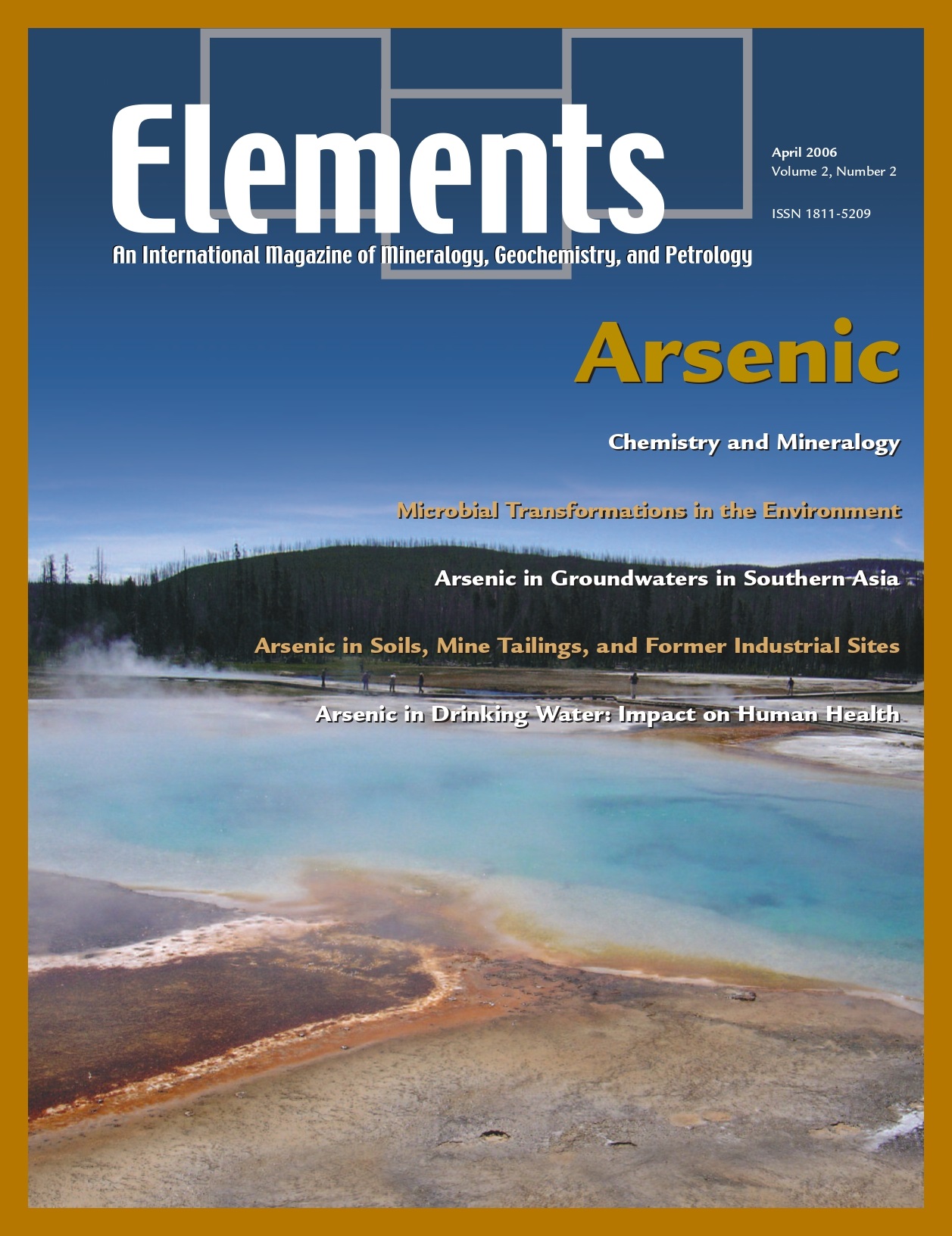
Arsenic, April 2006, Vol. 2, No. 2
$20.00
Arsenic is an element known throughout history as a classic poison. Currently, very small but highly significant concentrations of this element in drinking water supplies are causing massive health problems to many millions of people in some of the world’s poorest nations, and more localised sources related to mining and processing are also a concern.
Arsenic
April 2006, Vol. 2, No. 2
Arsenic is an element known throughout history as a classic poison. Currently, very small but highly significant concentrations of this element in drinking water supplies are causing massive health problems to many millions of people in some of the world’s poorest nations, and more localised sources related to mining and processing are also a concern. This issue of Elements presents background information on arsenic chemistry, occurrence in the Earth, production and uses, and its toxic properties.
Why You’ll Love Elements Magazine:
- Expert Contributors: Articles written by renowned researchers in the field of geoscience.
- Engaging Content: Join a community of readers who are passionate about Elements.
- Exceptional Quality: Each issue is printed on high-quality paper with stunning visuals and detailed illustrations that bring complex scientific concepts to life.
Order your copy of the April 2006 issue of Elements magazine today and explore the complexities of arsenic.
Related products
-
Diamonds, March 2005, Vol. 1, No. 2
$20.00Diamond, the fascinating ultrahard mineral, is the focus of considerable interest and scientific research. Recent advances particularly relevant to geoscientists include: diamond as a recorder of Earth processes from the perspective of inclusions, chemistry, and conditions of formation; synthesis for research applications and processing to modify color and physical properties, important to diamond gems and anvils; the implications of nanodiamonds from meteorites.
-
Early Earth, August 2006, Vol. 2, No. 4
$20.00The earliest Earth was a strange inhospitable world, yet transitions occurred culminating in the evolution of life within the first billion years. The preservation of a sparse and ambiguous rock record has encouraged debate.
-
Platinum-Group Elements, August 2008, Vol. 4, No. 4
$20.00The geoscientific and economic significance of the PGE is immense. Due to their extreme siderophile and chalcophile behaviour, the PGE are highly sensitive tracers of geological processes involving metal and sulfide phases.