Mineral Physics Applied to Earth and Planetary Sciences, April 2026, Vol. 22, No. 2
May 11, 2026
Elements Logo Embroidered Beanie
September 27, 2026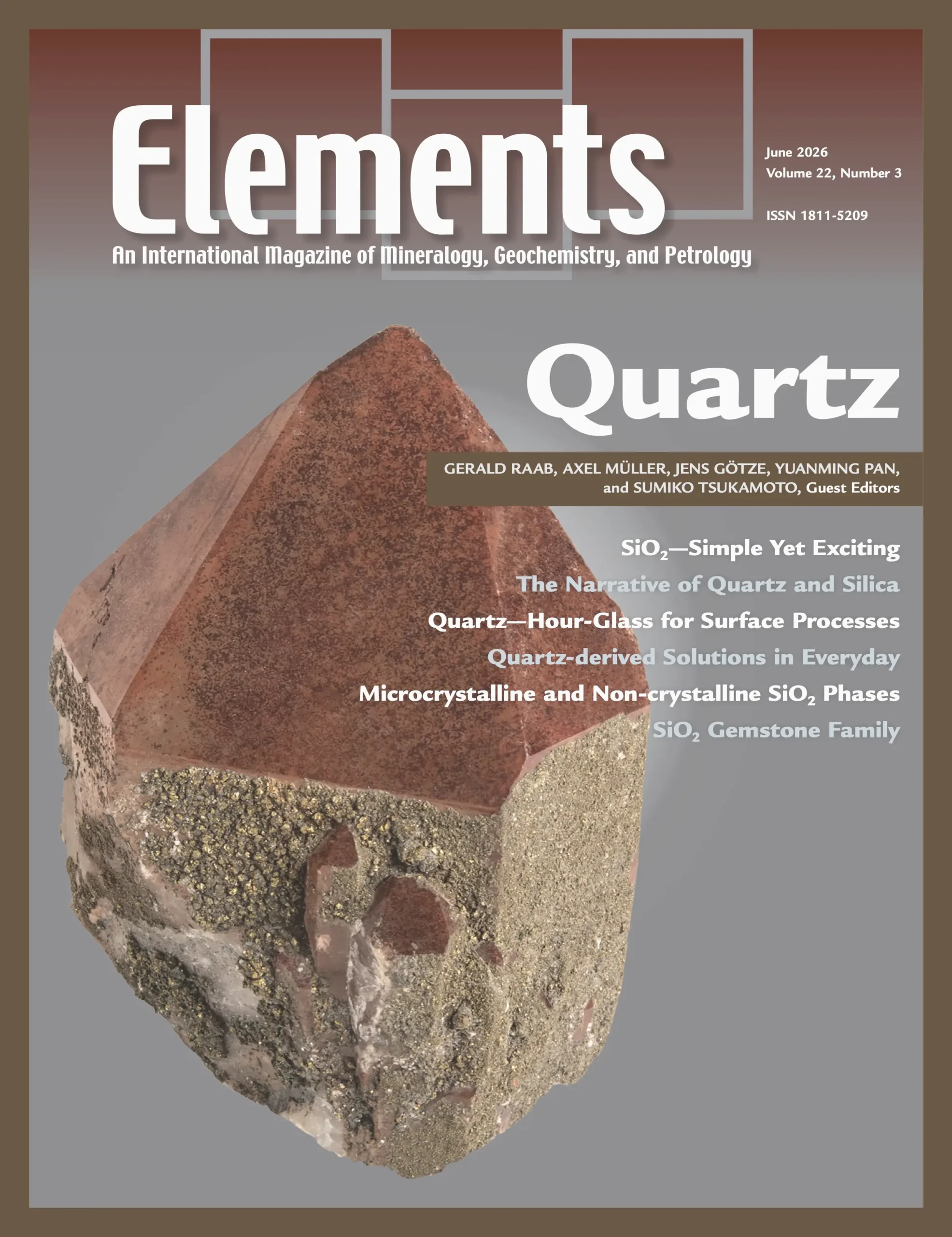
Quartz, June 2026, Vol. 22, No. 3
$20.00
Discover the fascinating world of quartz—the most abundant and versatile silica mineral on Earth. From its essential role in geological processes to its importance in cutting-edge technologies such as semiconductors, photovoltaics, satellites, and precision optics, this issue of Elements explores why quartz is one of the planet’s most significant minerals. Learn how quartz records Earth’s geological history while driving innovations that power modern society.
Quartz
June 2026, Vol. 22, No. 3
Quartz is one of the most abundant and important minerals on Earth. Although silica (SiO2) has a simple chemical composition, it exists in numerous crystal structures, making it one of the most fascinating mineral systems studied by geoscientists. As the most common natural silica polymorph, quartz is found throughout igneous, metamorphic, and sedimentary rocks and plays a vital role in understanding Earth’s geological evolution.
Beyond geology, quartz is indispensable to modern technology. High-purity natural and synthetic quartz is used in semiconductors, solar panels, precision optics, satellite gyroscopes, refractory materials, silicon metal production, and many other advanced industrial applications that support today’s digital world.
This issue of Elements presents a comprehensive exploration of quartz, covering its occurrence in nature, its role in the global silica cycle, its technological importance, and its value as a gemstone. The issue also examines how quartz preserves a wealth of mineralogical and geochemical information, providing valuable insights into geological processes, Earth’s history, and ore-forming systems.
Why You’ll Love Quartz:
- Explore Earth’s Most Important Silica Mineral: Learn about quartz, its many crystal forms, and its role in the Earth’s crust and the global silica cycle.
- Discover Its Technological Impact: See how quartz enables modern innovations in electronics, photovoltaics, precision optics, satellites, and semiconductor manufacturing.
- Unlock Geological Clues: Discover how quartz records mineralogical and geochemical information that helps scientists reconstruct geological histories and understand ore-forming processes.
- From Nature to Industry: Gain insight into the remarkable journey of quartz from common rock-forming mineral to one of the most valuable materials in modern society.
Expand your understanding of one of Earth’s most remarkable minerals and discover how quartz continues to shape both our planet and the technologies that define the modern world.
Related products
-
The Critical Zone, October 2007, Vol. 3, No. 5
$20.00The Critical Zone (CZ) encompasses all fluid, mineral, gaseous, and biotic components from the outer envelope of vegetation down to the lower limit of groundwater. It supports much of life on Earth.
-
Energy: A Geoscience Perspective, June 2007, Vol. 3, No. 3
$20.00The issue of energy resources in the future may be one of the most important in the 21st century. Future climate change and the ways to abate it while still supplying needed energy will impact future political relations, world economics, human health, and the environment.
-
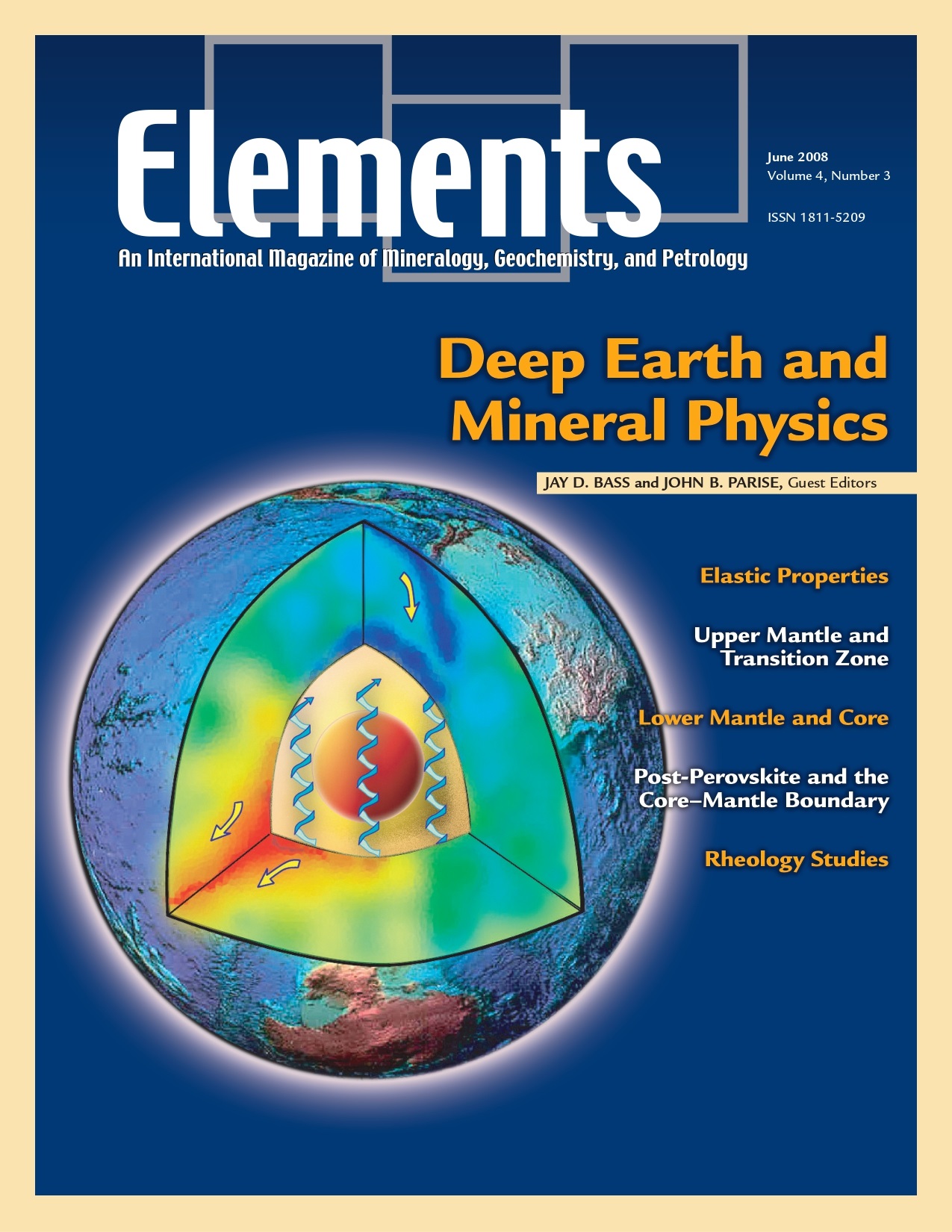
Deep Earth And Mineral Physics, June 2008, Vol. 4, No. 3
$20.00The field of high-pressure mineral physics is central to our understanding of the Earth’s interior and its evolution. It is also a field that is rapidly advancing.